
• Client Testimonials
  • Case Studies
  • Blog
tqmi-logotqmi-logotqmi-logotqmi-logo
  • Home
  • About TQMI
    • Core Values TQMI
    • TQMI Growth Map
    • Management Team
    • Expert Resources TQMI
    • TQMI Expert Panel
    • TQM International Experience
    • Janak Mehta Speech
    • Dr. Kano’s
  • Why TQMI?
  • Our Specializations
    • TQM/Deming Prize
      • International Experience
      • Deming Prize Client List
      • Client speak Testimonial
      • Deming Prize FAQs
    • Business Performance Enhancement
    • ICT / Digitization Service
    • New Product Development
    • Six Sigma Lean Six Sigma
      • Six Sigma Black Belt Certification
      • Green Belt Training Certificate
      • TQMI competence
      • Six Sigma Training
        • Six Sigma and Lean Six Sigma Training Experience
      • Support
        • Diagnostic Study
        • Project Facilitation
      • Success Stories
      • Six Sigma Consulting Services
      • Six Sigma Client list
      • Six Sigma Client speak
      • Case Studies
      • Six Sigma FAQ
    • Lean
      • TQMI Competence / LEAN
      • Lean Client List
      • Lean FAQs
    • TPM
      • TPM Training India Competence
      • TPM Training Success Stories
      • TPM Training India Client List
      • TPM Training India Client Speak
      • TPM Training India FAQs
    • Advance TQM Workshop
      • Advanced TQM Workshop 2026
      • Advanced TQM Workshop Client Testimonials
    • Data Science
      • Data Science Overview
      • Basic Python for Data Science
      • Exploratory Data Analysis
    • Industry 4.0
      • Industry 4.0 Workshop
    • SCEI
    • Value Creation
  • TQMI Knowledge Center
    • Six Sigma/Six Sigma knowledge sharing
    • Business Process Reengineering
    • TQMI Management Glossary
    • TQMI Case Studies
  • TQMI News & Events
  • TQMI Gallery
  • Contact Us
  • Home
  • About TQMI
    • Core Values TQMI
    • TQMI Growth Map
    • Management Team
    • Expert Resources TQMI
    • TQMI Expert Panel
    • TQM International Experience
    • Janak Mehta Speech
    • Dr. Kano’s
  • Why TQMI?
  • Our Specializations
    • TQM/Deming Prize
    • Business Performance Enhancement
    • ICT / Digitization Service
    • New Product Development
    • Six Sigma Lean Six Sigma
    • Lean
    • TPM
    • Advance TQM Workshop
    • Data Science
    • Industry 4.0
    • SCEI
    • Value Creation
  • TQMI Knowledge Center
    • Six Sigma/Six Sigma knowledge sharing
    • Business Process Reengineering
    • TQMI Management Glossary
    • TQMI Case Studies
  • TQMI News & Events
  • TQMI Gallery
  • Contact Us
The Importance Of Data Collection For The Six Sigma DMAIC Approach
  • Home
  • TQMI News & Events – Latest Updates, Announcements & Insights
  • Blogs 6 Sigma
  • The Importance Of Data Collection For The Six Sigma DMAIC Approach
Implementing TQM in Textile Business for Quality Excellence
October 24, 2017
How Can Six Sigma Benefit The Retail Industry?
November 2, 2017
Published by Deepak K on October 31, 2017
Categories
  • 6 Sigma
  • Blogs
  • Quality Management Strategies | TQMI Blog
Tags
  • 6 Sigma
  • DMAIC
  • Expert Insights on Quality Management Principles | TQMI Blog

The Importance Of Data Collection For The Six Sigma DMAIC Approach


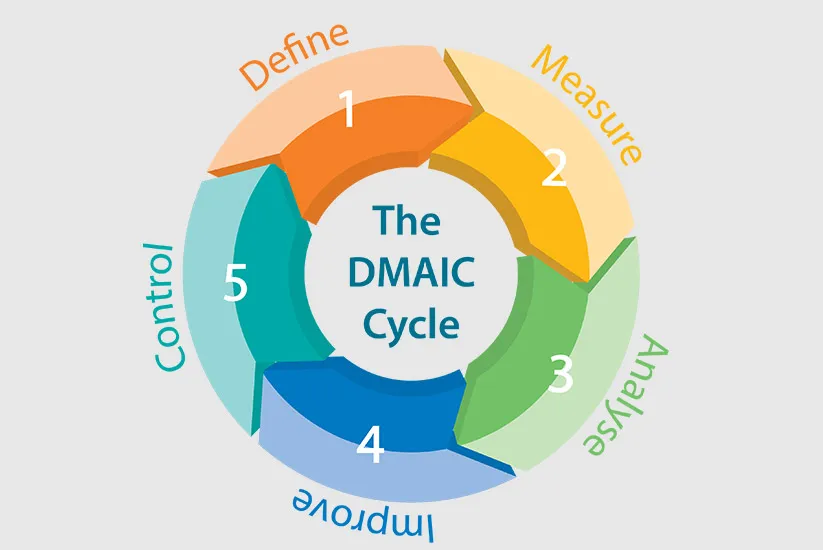
Six Sigma aims at achieving innovative improvement by reducing variation and defects; the most popularly used approach being the DMAIC model. DMAIC stands for Define – Measure – Analyze – Improve – Control.

  • Define – This involves identifying the problem, opportunity for improvement, goals, and customer requirements.
  • Measure – This involves measuring the performance of the process.
  • Analyze – This involves evaluating the process to determine the root causes of variation and defects.
  • Improve – This involves improving the process performance by eliminating those root causes.
  • Control – This involves controlling and maintaining the improved process.

Although all the five stages of the DMAIC model are important, and neither one can be performed without the other, today we will speak about the Measure phase, which is the lengthiest phase of the model.

The Measure phase includes data collection, wherein different types of data are collected and then forwarded for analysis and identification of possible root causes. Therefore, the understanding of various data types in very important. There are basically two types of data you must know about – discrete and continuous.

Discrete data


Discrete data is that which cannot be further broken down, and has a finite number of measurements that are based on counts. This type of data can be divided into three basic types.

  • Ordinal data – This is the data that can be put in an order, like 1st, 2nd, 3rd, etc.
  • Nominal data – This is the descriptive type of data that is not numeric, like names, colours, phone numbers, etc.
  • Binary data – This is the qualitative or categorical data that is made up of two classifications, like yes-no, on-off, good-bad, pass-fail, etc.

Continuous data


Continuous data is that which can be broken down further. This includes time, temperature, weight, height, money, etc. For example,

  • Time can be broken into hours, minutes, and seconds
  • Temperature can be broken into Degrees, Celsius, and Fahrenheit
  • Weight can be broken into kilograms, grams, etc.
  • Height can be broken into feet, inches, and fractions
  • Money can be broken into Rupees, Dollars, Yens, Euros, etc.

Let us now compare both these data types. Discrete data is less precise, less informative, less time-consuming, and cannot remove estimations. Continuous data, on the other hand, is more precise, more informative, more time-consuming, and can remove estimations and rounding of measurements.

How is data collected?


As we know that data collection is an important aspect of the Measure phase of the DMAIC model, the question is that how is this data collected. A data collection plan (DCP) is implemented to capture in a single place different data points required for the project. In this way, all the members involved in the project are brought together on the same page. A DCP involves the following –

  • The measurements that need to be recorded
  • The process through which the measurement is calculated
  • The kind of measurement metric that needs to be used in the process
  • The mention of whether the data is discrete or continuous
  • The mention of the type of sampling methodology used to collect data
  • The frequency at which the data needs to be collected
  • The person/machinery responsible to collect the data

Six Sigma carries many more important aspects and tools. For complete knowledge about the Six Sigma principles, functioning, and benefits, you need to opt for training that can help you achieve a professional Six Sigma certification in India from experts like TQMI.

Share
0
Deepak K
Deepak K

Leave a Reply Cancel reply

Your email address will not be published. Required fields are marked *

Related Tags
6 Sigma DMAIC Expert Insights on Quality Management Principles | TQMI Blog
  • Training at TATA Motors — Led by Mr. Anil Sachdev
    May 6, 2022
  • 0
    The Remarkable Leadership Legacy of Mr Rahul Bajaj in Indian Industry
    February 23, 2022
  • 0
    Data Analytics That Drives Remarkable Efficiency Gains for Manufacturers
    February 23, 2022
  • 0
    What is Total Quality Management (TQM) and Where Can it be Applied?
    February 2, 2022
  • 0
    3 Powerful Ways Data Analytics Transforms Indian Manufacturing
    February 1, 2022

Categories

  • 5S
  • 6 Sigma
  • Blogs
  • BPE Archives – TQMI
  • BPE Archives – TQMI
  • Datascience
  • Healthcare
  • Industry 4.0
  • Manufacturing
  • news
  • News & Events
  • Policy Management
  • Quality Management Strategies | TQMI Blog
  • Retail Industry Archives – TQMI
  • Service Industry Insights & Quality Management Blog | TQMI
  • Texile Industry
  • TQM
  • Training

Categories

  • 5S
  • 6 Sigma
  • BPE Archives – TQMI
  • BPE Archives – TQMI
  • Datascience
  • Healthcare
  • Industry 4.0
  • Manufacturing
  • Policy Management
  • Quality Management Strategies | TQMI Blog
  • Retail Industry Archives – TQMI
  • Service Industry Insights & Quality Management Blog | TQMI
  • Texile Industry
  • TQM
  • Training

Tags

5S 6 Sigma Accounting Firms Blackbelt BPE Archives - TQMI BPE Archives - TQMI Daily Work Management Data Analytics Data Fabric Data Management DataScience Digitalization DMAIC Dr. Kano DWM Expert Insights on Quality Management Principles | TQMI Blog Goals Greenbelt Healthcare Industry 4.0 Manufacturing Policy Management Quality Management System Retail Industry Archives - TQMI Risk Management Service Industry Insights | Quality & Improvement For Service Businesses – TQMI SIRI Six Sigma Texile Industry TQM TQM program by Dr Noriaki Kano
Get In Touch
TQM International Pvt. Ltd.
709, Vipul Business Park
7th Floor, Opposite S D Adarsh Vidhyala
Near Tikri More, Main Sohna Road,
Sector 48, Gurgaon – 122018
Telephone +91-124-4968989
mobile 09560510088
emailemail
Feedback
Feedback
Feedback
Feedback

Quick Links

  • About TQMI
  • Why TQMI
  • TQM / Deming Prize
  • Business Performance Enhancement
  • ICT Solutions
  • New Product Development
  • Six Sigma
  • Lean
  • TPM
  • Advance TQM Workshop
  • Data Science
  • Industry 4.0
  • Industry 4.0 Workshop

Quick Links

  • 4esoftware
  • Caizin
  • Knowledge center
  • Management team
  • Clients Speak
  • Projects
  • Case Studies
  • Blog
  • Glossary
  • News & Events
  • Gallery
  • Contact Us
  • Privacy Policy

Newsletter

Copyright © 2021 - TQM International | All Rights Reserved.

Let us reach out to you


    Use social media for ease


    Let us reach out to you


    hbspt.forms.create({ region: "na1", portalId: "8648325", formId: "60b9f37d-c567-48f1-a58f-a241e8283495" });
    null

    LIMITED OFFER!

    10% Instant discount for the team member of six

    Learn about the latest advances in TQM methods and its application

    Register Now

    Let us reach out to you


    hbspt.forms.create({ region: "na1", portalId: "8648325", formId: "c76bf870-9c0e-44ff-8e8c-c6511a485ec1" });

    WhatsApp us

    ×

    We don't do
    goodbyes

    We do see you later.

    In case, if you want to chat with
    us we are one step away.

    Let's Chat

    No, Thanks!