
How Digital Technology Is Reshaping Manufacturing Work
September 7, 2021
Experts Share Best Practices in Quality Management System Implementation
October 6, 2021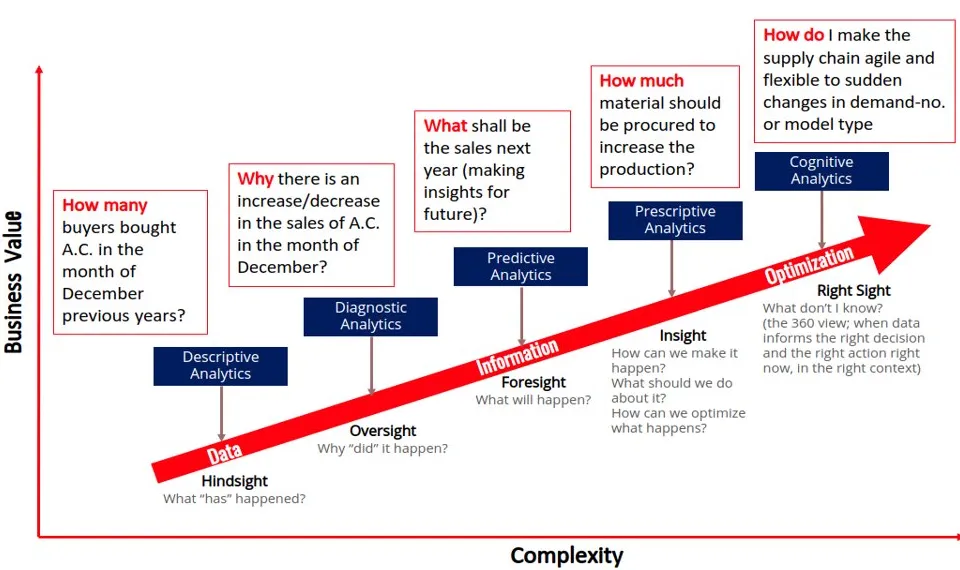
What You Need to Know About These Types of Analytics
Becoming a data-driven business is no longer an option, but a requisite. Given the amount of data being generated across the world today – 79 zettabytes (and growing continuously) – leveraging this data to enable different types of analytics and make intelligent and insightful business decisions can place organizations on the path to continual improvement.
So, what are these different types and analytics? And what should you know about them? Read on to find out!
The different types of analytics
The chairman of Gartner, Peter Sondergaard, once said, “information is the oil of the 21 century, and analytics the combustion engine” – and we couldn’t agree more.
Recently in an ETCIO Data Strategy Summit, experts are saying Data has become Oxygen for businesses.
Bringing all data and information to a central place and identifying patterns and correlations through analytics and applying mathematical and statistical models can enable organizations to identify bottlenecks as well as areas of improvement and sustain those improvements through continuous analysis.
Analytics can not only fast-track your digital transformation efforts; it can also enable business excellence to operate at peak effectiveness today, and every day.
Here’s what you should know about the top 5 types of analytics:
Descriptive analytics: Descriptive analytics examines data to provide answers to the question “what happened” or “what is happening”. By analyzing historic or current data, it helps organizations better understand the changes that have occurred during a set period. Using descriptive analytics, decision-makers can identify areas of strength and weakness and also get a holistic view of performance and trends on which to base their business strategy. For instance, using descriptive analytics, manufacturing companies can evaluate productivity levels or track downtime. Through careful examination, they can then identify patterns or trends that lead to poor efficiency and take steps to optimize machine performance in the future.
Diagnostic analytics: Another type of analytics that more and more businesses are found embracing is diagnostic analytics. It goes a step further from descriptive analytics, providing answers to “why it happened” or “why it is happening” – and is less focused on what happened but rather why something happened. It helps organizations look at the reasons or causes of a particular event or issue, instead of the result – while providing solutions on how the problem can be avoided or how a solution can be duplicated. In the manufacturing setup, diagnostic analytics can help uncover the cause of failed equipment. Shop floor managers can narrow down the reason based on detailed analysis – either due to lack of maintenance, improper operation by the worker, or overuse.
-
Predictive analytics: Predictive analytics analyzes historical (and current) data to provide answers to the question “what will happen” in the future – based on past or current trends. With predictive analytics, organizations can base future decisions based on past performance and better plan for what’s going to come. Right from improving business process efficiency to planning for predictive maintenance, optimizing system performance to enhancing productivity levels – the use cases for predictive analytics in the business landscape are many. For example, manufacturers can use predictive analytics to better forecast customer demand during a particular season. By analyzing data for the same period across preceding years, they can get a rough picture of the expected demand, and run their production cycle accordingly.
Prescriptive analytics:Prescriptive analytics helps organizations in answering the question “how can we make it happen”, enabling them to take the required steps to arrive at a particular outcome – and also provide insight into what will happen once the outcome is reached. By using descriptive, diagnostic, and predictive data, prescriptive analytics provides recommendations for future actions and improvements, while helping organizations make smart, future-focused decisions that consider evolving customer needs and changing trends. The manufacturing industry can use prescriptive analytics to see where process improvements can have the biggest impact on their bottom line. For instance, if an equipment issue has resulted in significant downtime, prescriptive analytics can enable manufacturers to understand what maintenance activities they should undertake to avoid a similar failure in the future.
Cognitive analytics: One of the most advanced forms of analytics is cognitive analytics that provides answers to the question “what don’ t we know”. It uses multiple analytics techniques to analyze large volumes of data with human-like intelligence. Right from understanding the context of a customer query to recognizing trends in a large data set – using artificial intelligence and machine learning algorithms, cognitive analytics reveals patterns and connections that simple analytics cannot.
Manufacturers can use cognitive analytics to optimize production processes in ways that were previously not possible. By pulling relevant information in real-time and finding patterns in structured and unstructured data, cognitive analytics can help spot business opportunities while taking care of critical issues in real-time. Manufacturers can use cognitive analytics to streamline processes, minimize risk, and also pivot according to changing circumstances.
Businesses need to be able to respond to evolving market trends, customer demands, and equipment issues with increased agility and precision – to optimize throughput, cost, and speed. Embracing these different types of analytics is a great way to understand what or why something happened, what is likely to happen in the future, and also get recommendations to reach the desired result. In the long run, all these types of analytics can help optimization of businesses.
What stage of Analytics or what types of analytics your business has already implemented? If you need experts to validate, reach out to me.